Important Tests during pregnancy help check the baby's growth and health, as well as the mother's well-being.
Preconception Checkup: ‘Planning’ is the word we are constantly hearing from newly married couples about pregnancy, and as technology increases even taking care of their pregnancy has increased.
That is the reason everyone is going for preconception checkups for a healthy pregnancy, even though they are planning for a first or second child or history of an abnormal child in the family. It will be very useful.
Are you looking to plan for pregnancy, or do you need to plan for it in the future? It's never too late to plan a pregnancy with good health for your baby.
Also Check: Pregnancy Symptoms Vs PMS Symptoms
Making preconception checkups will help treat your health problems before the pregnancy itself to give your baby a good start in life.
And even it is a good idea to go for a preconception checkup where you want to be treated even after pregnancy.
- What is Preconception Checkup | Why It is Important?
- How Should I Prepare For My Preconception Checkup | What Will Happen At Preconception Checkup
- Health History Review: Check your Health Condition to Know Whether it may Affect your Pregnancy.
- Discussion of Medication & Supplements
- Test and Screenings At Preconception Checkup
- Lifestyle And Nutrition Advice | What Changes To Be Made After Preconception Checkup?
- When should you get a preconception checkup?
- Is a Dental Checkup necessary before pregnancy?
- Do you need a preconception checkup if you are already having a baby?
- When to stop your birth control if you are trying to conceive?
What is Preconception Checkup | Why It is Important?
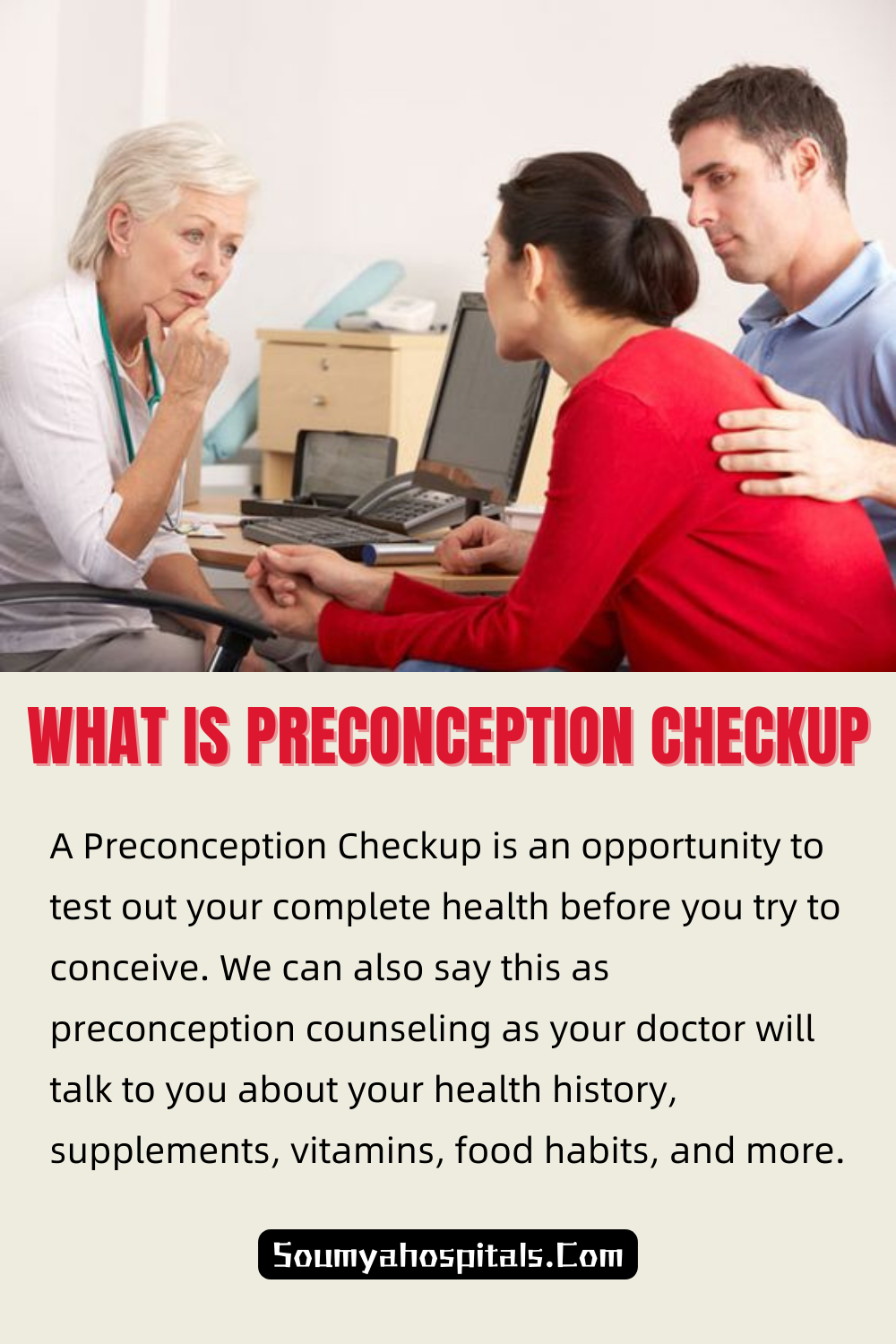
A Preconception Checkup is an opportunity to test out your complete health before you try to conceive. We can also say this as preconception counseling as your doctor will talk to you about your health history, supplements, vitamins, food habits, and more.
Even they tell you how to take care of your health by taking folic acid, supplements, and vitamins, and when to stop birth control. Will take tests and tell you about your lifestyle, food habits, and nutrition that you need to change.
The main aim of this preconception checkup will be to make you get pregnant and give you a healthy baby by reducing the risk of pregnancy complications.
Many of the pregnancies were unplanned, but taking the preconception checkup before getting pregnant is a good thing for you and your baby.
How Should I Prepare For My Preconception Checkup | What Will Happen At Preconception Checkup
When considering making an appointment with your healthcare provider, you need to be prepared to answer the questions your healthcare provider asks.
In this preconception checkup, your provider will check your overall health and tell you about the medications you need to take care of.
Knowing what your health care provider asks you with our article, will make you strong. When you go for a preconception checkup you and your healthcare provider talk about below points.
Health History Review: Check your Health Condition to Know Whether it may Affect your Pregnancy.
Your provider will first ask about your health conditions because you may have asthma, diabetes, being less weight than normal, high blood pressure, or thyroid.
- Even they will check that you may have any infections like toxoplasmosis, and Sexually Transmitted Diseases (STDs).
- Because any of these infections or health conditions may affect your body and your baby during pregnancy.
- Even your doctor wants to know about your previous health conditions like problems with anesthesia or if you have been hospitalized for any reason.
- Also, your Obestrician may ask you about chronic diseases if you have any, if you say yes, then they also ask you about the dosage, as all these things help you to give birth to your baby in a healthy way.
After the completion of asking about your present health, the care provider may also ask you about your obstetric history.
- They ask you about whether you had a pregnancy in the past or not like ectopic pregnancies, or abortions.
- Even they ask you about recurrent miscarriages and abortions. They ask you about this history because all these may affect your fertility.
- If you are already the mother of one child and planning for the next, then ask you about your previous pregnancy experience, and complications, if you have any.
- Doctors want to know after pregnancy which you before after that if you have any health complications or not like postpartum complications or depression.
- Finally, after asking all of this, she asks about your previous child's birth, and does they had any complications or not. If you have they provide you medication not to repeat.
After knowing all these details your care provider will ask about your Gynecological History.
- Will you get your period regularly or not, what is your menstrual cycle? Like 28 days or 30 days.
- And also they ask you about having any PCOD or PCOS problems, and if you are using any birth control pill or not.
- Even if your relationship is not monogamous it means that your partner has many relationships sexually then it is important to check about STIs.
- Even your doctor will ask you about your family history on both sides like from the wife's side and the husband's side. To check whether there are any genetic disorders. If you have any then the obstetrician may recommend you to a genetic counselor.
- Your doctor may also recommend you about mental health problems like depression or eating disorders.
Discussion of Medication & Supplements
After that, your provider also asks you about your medications or vaccination history and also about your supplements if you are taking any.
- If you are taking any medications, your provider may ask you about the medications that you are taking and also ask that is there any allergies to those medications.
- As you are going for a preconception checkup, it is better to write about the list of medications, vitamins, supplements, or herbs that you take in your daily life.
- Your provider will check those medications and help you whether to continue or not during the pregnancy.
- Even if you are taking too much of Vitamin supplements then he/she can help you with teh correct dosage that will be helpful in pregnancy.
- In these supplements, if you are not using folic acid, your provider may suggest you start taking it with 400 micrograms a day.
- And it should be taken before at least one month. As it can prevent most of the congenital birth defects for your baby like neural tube defects.
- The doctor may also ask you about the vaccinations for infections like Hepatitis B, Rubella, chicken pox, Covid 19, HBV, Zika Virus, HIV, and Measles.
- Hepatitis B: Hepatitis B is a viral infection that directly affects your liver. And if you are at high risk of it, it is better to take vaccinations which will be three of hepB. Do not take it before your pregnancy itself. Continue taking during the pregnancy.
-
- Measles, Mumps, Rubella (MMR): It is also a viral disease that will cause rashes and fever. Before pregnancy itself, you need to take this vaccination if you have not taken it till now from childhood.
- Chicken Pox (Varicella): From the small many of you have chicken pox, if you have not got it yet or have not taken vaccination till now, it is better to take the vaccine at least one month before you start trying to conceive.
- Covid 19: Still you have not taken the medication yet. Then this is the time to take the COVID-19 vaccination which is recommended by doctors, that vaccination will help your immune system fight with covid 19.
- HBV (Human Papilloma Virus): And also this vaccination is also needed if you are trying to conceive before the age of 26. It comes in three doses. But continue vaccination during and after pregnancy.
- If it is flu season when you go for a pre-pregnancy Checkup, the doctor will prescribe to take that vaccine also.
- Even when you are trying to conceive, if you are going around the world, then the doctor may also prescribe vaccines.
- Even you need to skip the alcohol, and smoking if you are trying to conceive.
Test and Screenings At Preconception Checkup
Once your healthcare provider completes the counseling, asks you about your health history, and discusses vaccinations, medications, and supplements, your doctor may examine you with some tests by taking all that information.
So that once after the results then the doctor can help you with medications, nutrition, and lifestyle. Look at the series of tests that were given below.
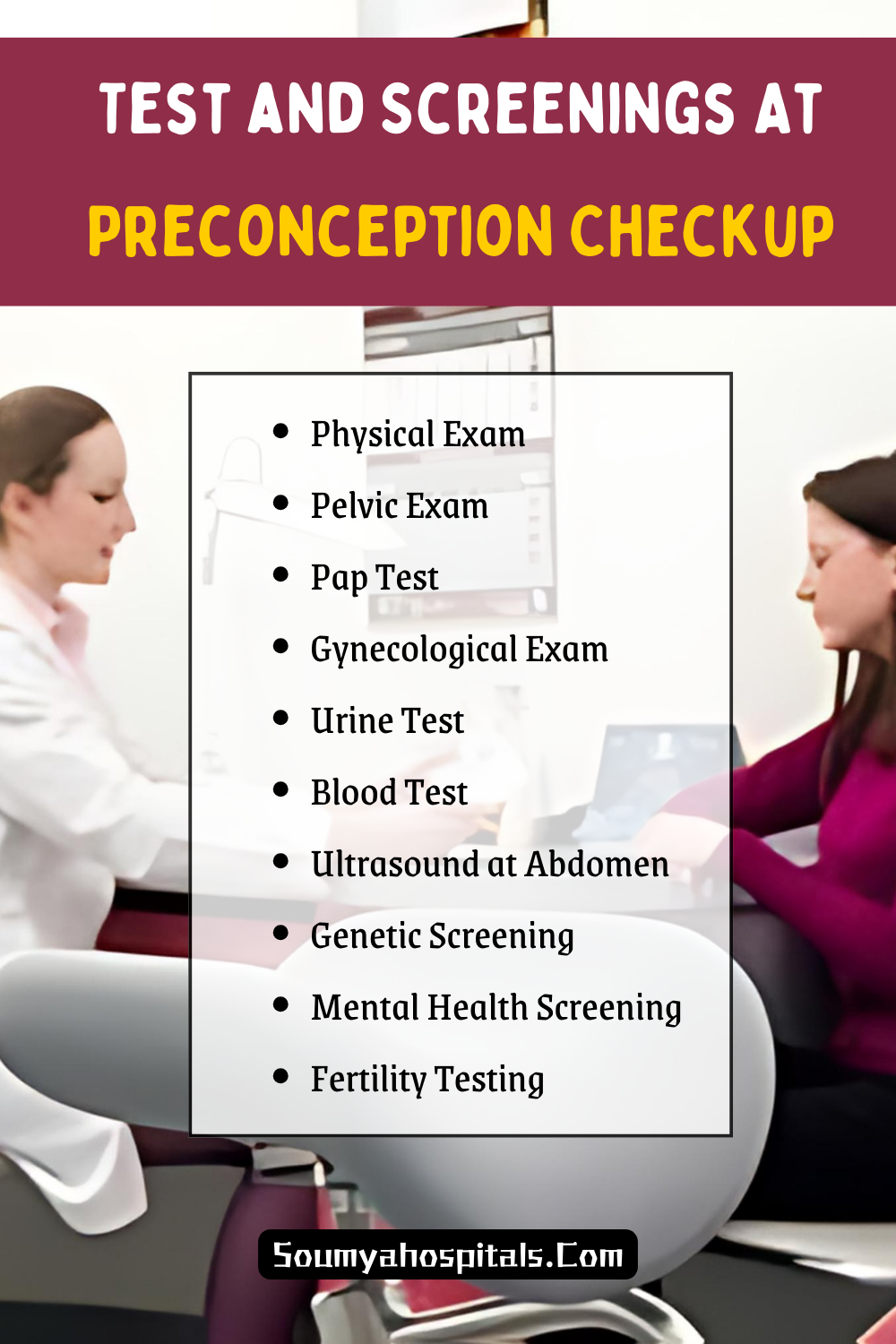
- Physical Exam
- Pelvic Exam
- Pap Test
- Gynecological Exam
- Urine Test
- Blood Test
- Ultrasound at Abdomen
- Genetic Screening
- Mental Health Screening
- Fertility Testing
Physical Exam: In this physical examination test, they take the complete details about your weight, and blood pressure, and also check your complete organs like heart, lungs, and abdomen and look for signs of any health issues.
Pelvic Exam: A pelvic exam will be examined your cervix, vagina, uterus, and ovaries to check that they are healthy or have any issues. If they find any issues with these your provider will provide a good treatment that helps you for a safe pregnancy.
Also, this test will be done to check whether you have any tenderness, lumps, or masses.
PAP Test: Doing a PAP test before pregnancy will help you to know whether there is a chance of any cervical cancer. This will be done by taking cells from your cervix.
Gynecological Exam: In this examination, they will examine whether there is any chance of infections like STIs or HPV HIV any other or do you already have them or not.
By doing this your provider can treat you before you get conceived.
Urine Test: To get confirmation about the Urine tract infection your provider will ask you to do a urine test. In this test, if sugar is identified then immediately your doctor will suggest you take the glucose tolerance test to check for diabetics.
Blood Test: A blood test will be done to know about your blood count and also to know about your blood type. Another important thing to test blood is to know your RH factor. Knowing about the RH factor whether it is negative or positive is important.
In blood tests, we can know everything about infections like we have seen above which are hepatitis B, HIV, tuberculosis, and many more.
Ultrasound for Abdomen: The ultrasound test will be done for your abdomen, to know whether there are any ovaries or cysts present in the abdomen and to check your uterine size along with that they check if you have any fibroids.
Genetic Screening: When your doctor asks you about your family history, if they think that you may have any genetic disorders then genetic screening will be done.
Some of the genetic disorders might be sickle cell disease, Fragile X syndromes, and others. Also, do chromosomal analysis, whether there is a chance of chromosomal abnormalities.
Mental Health Screening: This screening will be done to check if you have any mental health issues like depression, eating disorders, anxiety, mood disorders, and others.
Fertility Testing: Last but not least fertility testing will be done by your provider to know if you have any fertility issues.
In this test, they check your basal body temperature which tells you about your fertile days, the Ovulation test checks ovulation hormones, the Tubal Patency test checks your fallopian tubes are open.
Also test the Uterine cavity to check everything is fine without fibroids.
Lifestyle And Nutrition Advice | What Changes To Be Made After Preconception Checkup?
Once after complete your preconception checkup with the test, talk to your provider about your health habits, family history, health history, and everything.
Your healthcare provider may advise you about some lifestyle, health care, and nutrition suggestions like:
- You need to lose or gain weight according to your weight test.
- Need to increase the Nutrition in your food according to the suggestion given by the doctor.
- You need to quit smoking and drinking.
- Important to develop a healthy exercise plan.
- Avoiding to be stressful and learning to be stress-free.
- Taking vitamins or supplements that are suggested by your doctor.
- You need to get in touch with the specialist doctors for your mental or genetic health problems.
- You need to stop taking medications that are harmful to your body and your baby.
- Update your immune system.
FAQs on Preconception Checkup Before Pregnancy
1. When should you get a preconception checkup?
Preconception checkup can be taken any time but taking 3 months to a year before you are trying to conceive will be very useful.
2. Is a Dental Checkup necessary before pregnancy?
Yes, having a dental checkup frequently after and before you get pregnant will help you to keep away your baby from gum diseases which will make your baby premature or low birth weight.
3. Do you need a preconception checkup if you are already having a baby?
Even if you are already having a baby and thinking of a second baby, then it is better to go for a preconception check-up.
If your first baby is having any complications during pregnancy or after pregnancy, a preconception checkup is recommended.
4. When to stop your birth control if you are trying to conceive?
If you are thinking of a baby you need to stop your birth control medication a few months before you start trying. It is good to go for preconception checkup and take doctors advice when to stop.
Conclusion
Every woman should visit the OB/GYN at least once a year to avoid many health problems that are inside her body. And pre-conception checkup will be very useful before you get conceive to avoid many complications.
When you go to the provider you just ask them the doubts that you have. As you have checked out the article completely, hope you got an idea of what is this preconception checkup, why you need this, or what will do in this checkup.
Make an appointment for a preconception checkup without any fears.